Belgium / A capital on two levels
A lower town, an upper town and two quarters to the east. It helps to know what each one holds.
A bronze boy 55.5 centimetres tall at a fountain, whose original stands in a museum on the Grand-Place. The Town Hall tower that the guns of 1695 aimed at and failed to bring down. A triumphal arcade between two museum wings, and a park with a dinosaur gallery at its edge. Choose a route and we’ll explain what you pass along the way.
Choose your route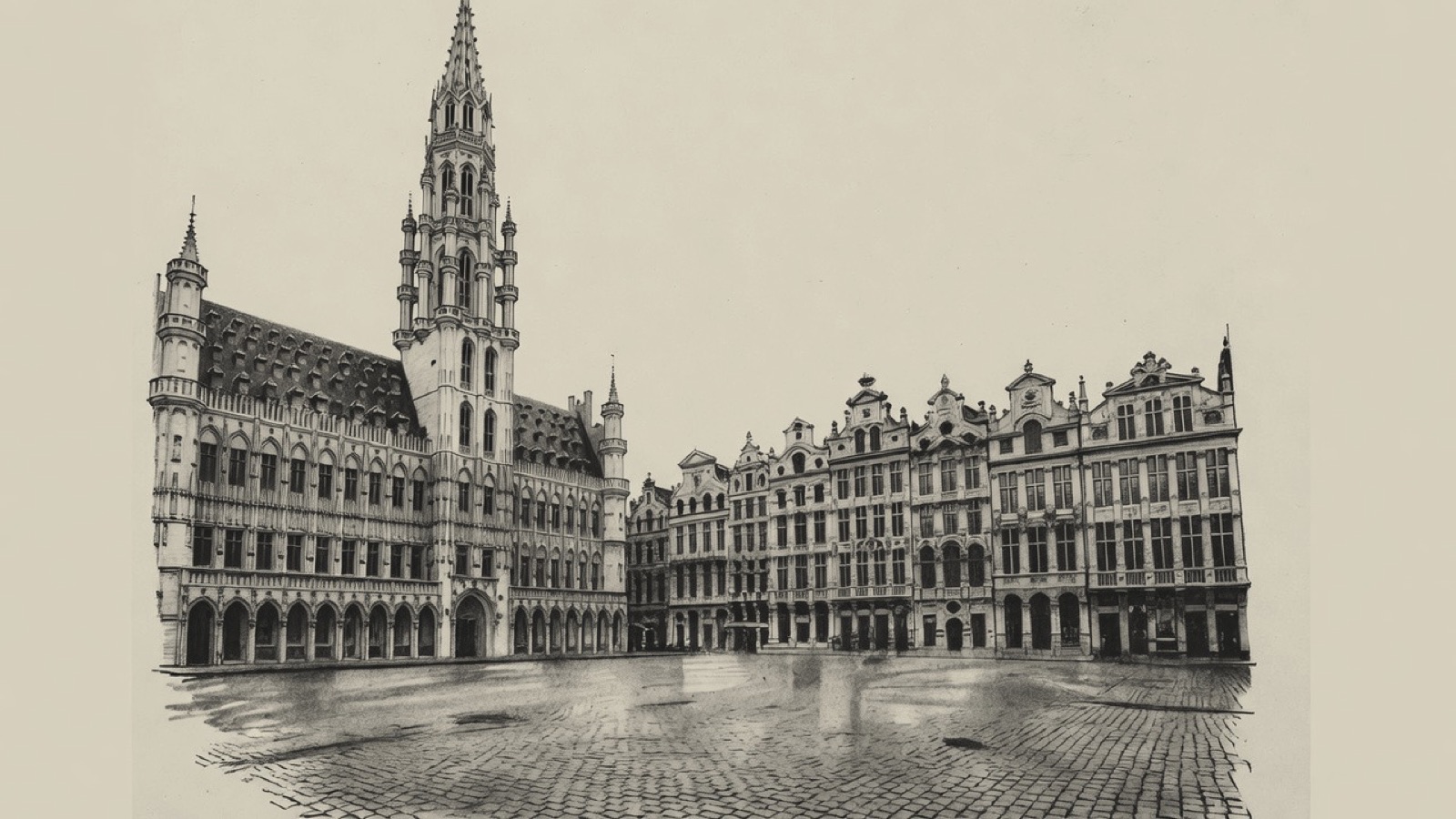
01 / Choose a walk
Four ways into Brussels
Start with the part of the city that interests you. Each route puts its stops in walking order, with the map ready to open when you need it. You decide where to pause and when to continue.
01Gothic & folk humour
Central Brussels: Gothic buildings and three bronzes
A bronze girl behind iron bars, a bronze dog at a bollard and a bronze boy in a niche of blue stone are spread along this walk through central Brussels. Between them come a 96-metre Gothic tower, three arcades under a glass roof and a square created after the river Senne was covered.
02Courts, churches, collections
Sablon to the Royal Quarter: courts, churches, museums
A cupola rebuilt higher than the one the Second World War destroyed, a Baroque slate bell tower, a former Art Nouveau department store that houses a museum, and a paved square with a rider at its centre. The route runs from the Palace of Justice through the Sablon and the Royal Quarter to the Small Ring.
03Exhibitions & museums
Cinquantenaire Park: halls of the 1880 jubilee
A triple arch carrying a quadriga in bronze, exhibition halls laid out in a U, and, at the park's north-western corner, a mosque put up in 1897 as an exhibition sight. The halls hold cars, military history and antiquities.
04Science & Europe
European Quarter: from Iguanodons to Parliament
Thirty Iguanodon skeletons, a pond with Egyptian geese and rose-ringed parakeets, a resin statue made by visually impaired children and a chapel copied from a fifteenth-century church. The walk ends on the square that European officials and journalists call Plux, beside the European Parliament.
Our first four routes cover the lower town, the upper town, the Cinquantenaire and the European quarter. Laeken and the Atomium, the Marolles and the districts south of the Palace of Justice are not yet included in the route collection.
Your pace, your stops
We don’t give walking times: everyone moves through a city at a different pace. A route is a suggestion that links places worth seeing. You decide where to stop and what you can take on today.
How these routes were made
The Brussels routes were proposed from open map data, written from published sources and illustrated in charcoal. The walking tracks were calculated on a map and have not yet been checked on foot. The drawings are interpretations, not surveys. Read how the guide is prepared.
02 / Before choosing
The places to make room for
The four routes are walked in the street, but several of their stops are museums that need a visit of their own. These are the places to bear in mind as you choose what to explore.
01
The Grand-Place and its Town Hall
The lower-town route reaches the square that the City of Brussels calls its centre: the Town Hall, the guild houses and the Maison du Roi on its four sides. In August 1695 a French bombardment destroyed most of the houses; the façade and tower of the Town Hall, which were the target, stayed up, and the guilds rebuilt in stone. The square is seen from outside. The Brussels City Museum in the Maison du Roi is a separate visit.
02
The Royal Museums of Fine Arts
On the upper-town route, between the Sablon and Place Royale. The Royal Museums of Fine Arts of Belgium are several museums under one name, the Old Masters and the Magritte Museum among them, and the Musical Instruments Museum stands a few doors further on the same route. Check the museums’ own page for what is open: the Wiertz Museum, which belongs to the group, was closed for renovation when we looked.
03
The museums of the Cinquantenaire
One park, an arcade and three institutions: Autoworld, the Royal Museum of the Armed Forces and Military History, and the Art & History Museum. The last shows Brussels tapestries and altarpieces, Aztec and Maya sculpture, and Belgian Art Nouveau and Art Deco. Its Antiquities wing is closed for renovation with no reopening date, so read the museum’s notice before planning a visit around the antiquities.
04
Leopold Park and its two museums
The European-quarter route starts at the Museum of Natural Sciences, whose permanent Dinosaur Gallery holds the Bernissart iguanodons, and enters Leopold Park, where the House of European History stands. The House of European History lists free entrance on its own site. The route ends on Place du Luxembourg, in front of the buildings of the European Parliament.
03 / Look closer · Manneken-Pis
The figure at the fountain is a replica.
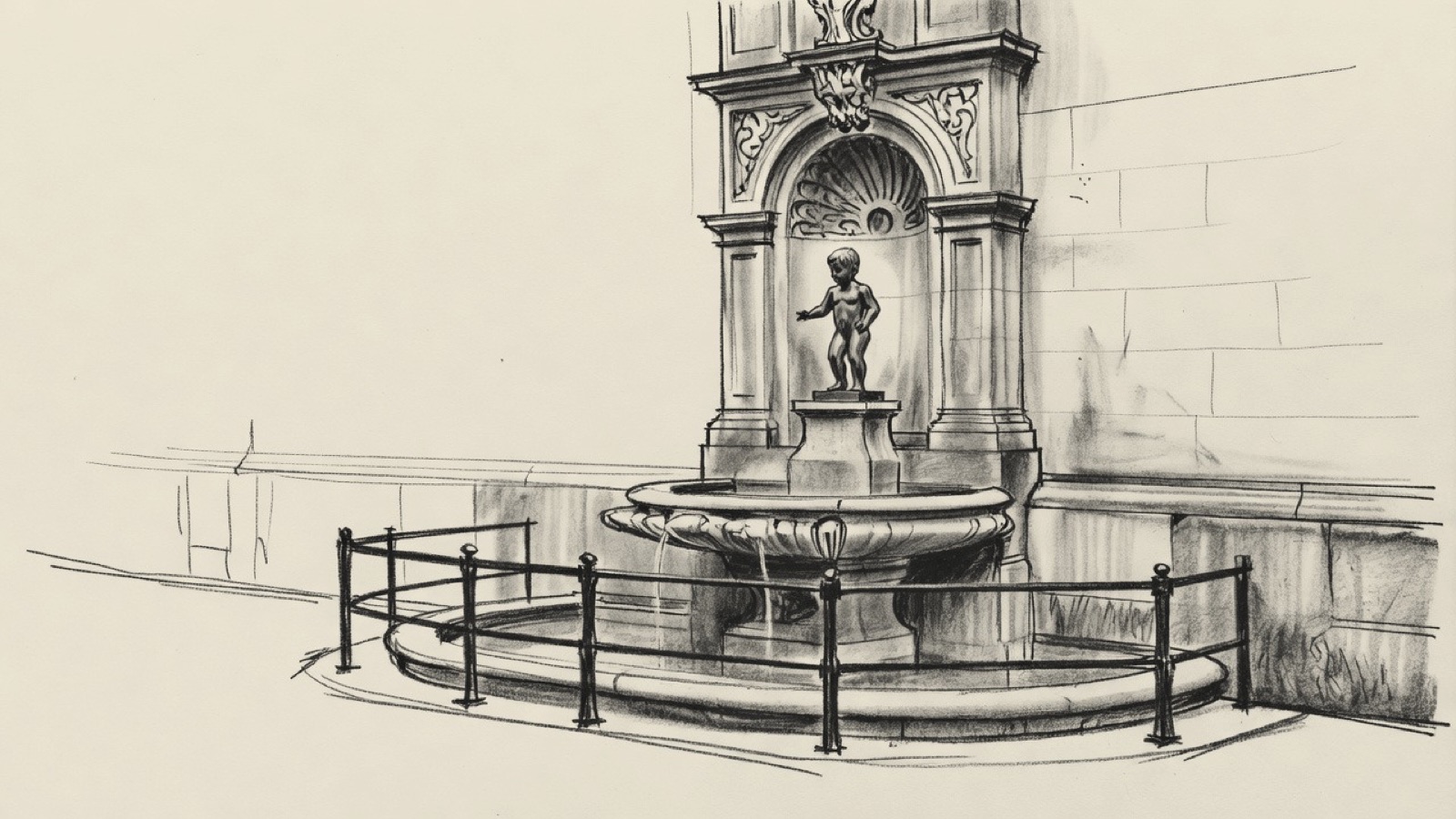
Manneken-Pis is 55.5 centimetres tall and weighs 20 kilograms. A fountain of that name is first mentioned in 1451, when it was part of the network that brought drinking water to the city. In 1619 the City commissioned Jérôme Duquesnoy to cast a new bronze, and that figure came through the bombardment of 1695.
It is not the one at the fountain today. The statue was stolen once more in 1965 and found a year later in the Brussels–Charleroi canal. The City then put Duquesnoy’s bronze in the Brussels City Museum, in the Maison du Roi on the Grand-Place, and set a replica in its place. The lower-town route passes both: the museum first, the fountain at the end.
The clothes are older than the copy. The earliest evidence of the figure being dressed dates from 1616, and the oldest outfit still in the collection was a gift from Louis XV of France in 1747. In the eighteenth century it was dressed at least four times a year. Today a City employee dresses it, 23 dressings fall on fixed dates, and new costumes arrive by a formal request to the Board of Mayor and Aldermen, which accepts none with an advertising, commercial, political or religious character. The wardrobe, which the City counts at more than 900 costumes, has its own museum at Rue du Chêne 19.
Before you go. The wardrobe museum says the figure is dressed for nearly half the year and publishes the calendar month by month, so on many days you will see a costume, not the bronze. To see the 1619 original, check the City Museum first: it has announced a full closure from 3 January to 2 March 2027 for work on the roof, and only its ground and first floors open after that.
The wardrobe museum’s facts about the statue and its original →
04 / Getting around
Walk the quarters. Take the metro or tram between them.
The city’s tourist office describes Brussels as compact, with everything within reach on foot or by public transport. Each of the four routes is walked from end to end. Metro, trams and buses, all run by STIB/MIVB, are for the gaps between one quarter and the next.
Arriving by train
The tourist office counts five main stations, all connected with each other: Central, South, North, Luxembourg and Schuman. South is the Eurostar station for London, Paris and Amsterdam. It has two names for one place, Bruxelles-Midi in French and Brussel-Zuid in Dutch, and both may appear on a ticket or a departure board. SNCB lists luggage lockers at Central and at South, a metro connection at both, and trams at South. Central is on Carrefour de l’Europe; Schuman is the station the tourist office names for the European institutions. Check which station is on your ticket before getting off.
From the airports
Brussels Airport has a railway station directly under the terminal, with direct trains to Brussels-North, Brussels-Central and Brussels-South and, the airport says, two trains an hour to the European quarter. Journeys to and from that station carry a rail supplement, €6.90 on the airport’s page when we checked; SNCB says it is already in the price of an ordinary ticket and does not need to be bought separately. Keep the ticket to hand: its QR code opens the station gates. STIB/MIVB also runs an Airport Line bus between the airport and the European quarter. Towards the airport any STIB/MIVB ticket is valid on it; from the airport you need the Airport2City fare shown below.
Brussels South Charleroi Airport is a different airport, a good deal further out. Its own website lists shuttle buses to Brussels-Midi station, timed to the flights and sold by the coach operator from €14.99 when we checked, and as an alternative a TEC bus to Charleroi’s main station with a combined bus-and-train ticket sold by SNCB.
Metro, trams and buses
One ticket covers metro, tram and bus, and changes are free for 60 minutes after the first validation. STIB/MIVB says most of its lines run seven days a week from 5.00 am to midnight. At a stop above ground, raise your hand for the bus or tram you want: drivers are not required to stop at every stop. Press the button in good time to get off. Metros and underground trams stop at every station. On Friday and Saturday nights the Noctis night buses leave from beside Central station between midnight and 3.00 am, at the ordinary fare. Look up the line for each journey in the STIB/MIVB planner on the day; we do not print line numbers because networks get diverted and renumbered.
Single journey · contactless
Hold a bank card, phone or watch to the contactless validator on the bus or tram or at the metro gate. Changes within 60 minutes are free if you validate the same card each time. One card pays for one traveller. The day’s total is capped at €8.50.
Brupass · 10 journeys
Ten journeys of 60 minutes, loaded on a MOBIB card or bought as a digital ticket in the STIB/MIVB app. Several people can share one: validate once for each traveller. Also valid on SNCB trains and on De Lijn and TEC buses inside Brussels.
Airport2City · from the airport
The fare for the STIB/MIVB Airport Line bus when you board at Brussels Airport, charged automatically if you pay contactless on the bus. It costs the same on a MOBIB card and €8.40 as a paper ticket, and allows changes across the network within the first hour.
Count the journeys before buying. Four contactless journeys would come to €9.60, so the €8.50 cap is reached with the fourth journey of the day and the rest are free; that is less than the €9 paper day ticket. A single journey on a paper ticket costs €2.90, and paper tickets are not sold on board. The 10-journey Brupass works out at €1.89 a journey in the app. On a new MOBIB card, which costs €6, the first ten journeys come to €24.90, more than ten contactless singles. Contactless payment is valid on STIB/MIVB only; for a train inside Brussels you need a Brupass, €2.70 for one journey. Children under six travel free and need no ticket. Travelling without a validated ticket carries a surcharge of €107.
05 / At the table
A few words worth recognising on a menu.
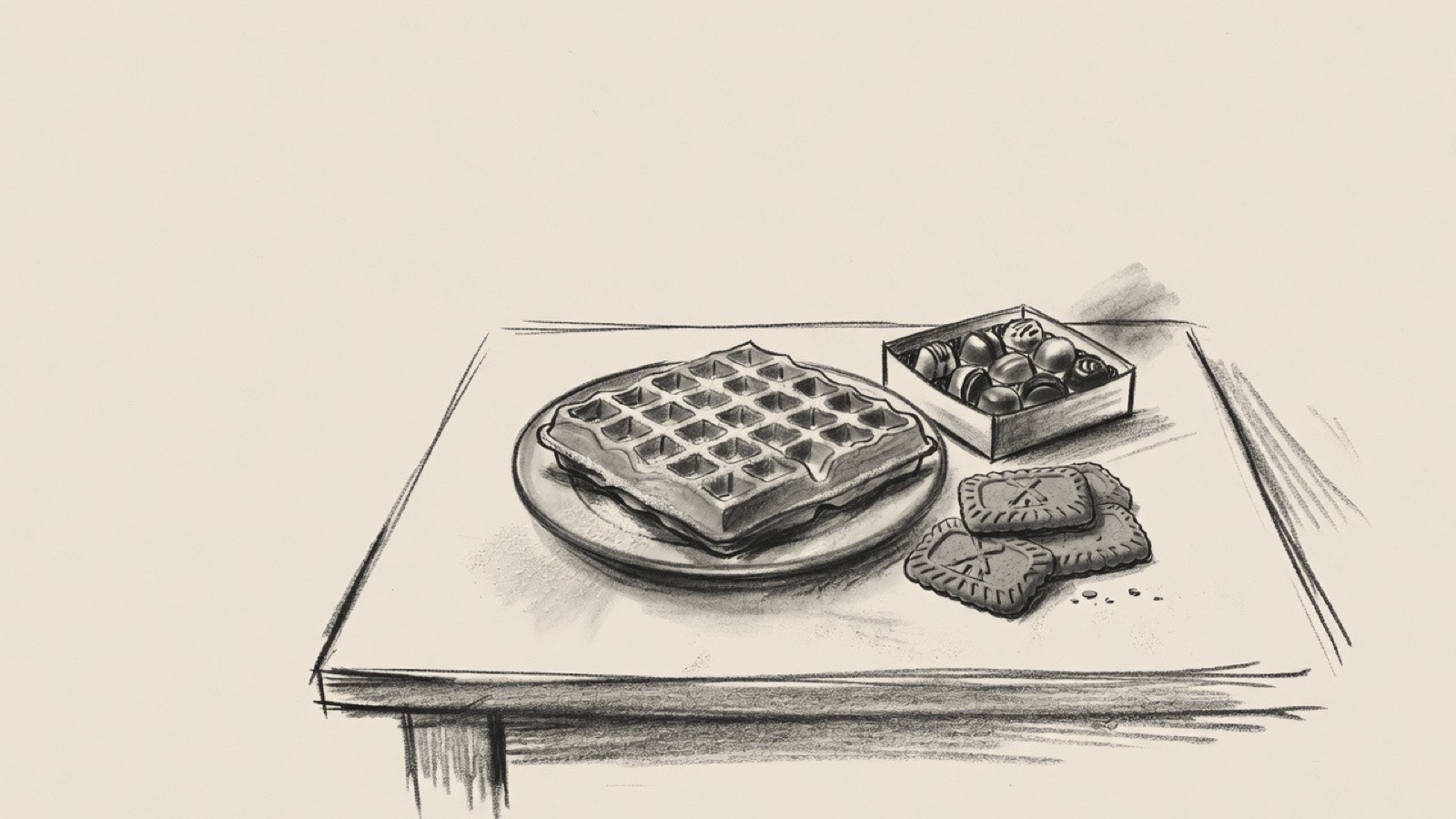
Brussels cooks from the Belgian repertoire and adds a few names of its own. Recognising the words is more useful than arriving with a list of things to tick off.
Brussels waffle
Rectangular, light and unsweetened, with a crisp outside; the topping does the sweetening, traditionally icing sugar. The tourist office gives 20 to 24 holes as the way to tell it from the Liège waffle. Jacob Jordaens painted waffles on the table in The King Drinks, which hangs in the Royal Museums of Fine Arts on the upper-town route.
Speculoos
A crunchy biscuit flavoured with cinnamon, with cloves, nutmeg and ginger behind it, and a little brown sugar.
Pain à la grecque
A sweet flatbread covered in pearl sugar, typical of Brussels. Nothing about it is Greek, whatever the name says.
Praline
In Belgium, a filled chocolate. The tourist office dates it to 1912 and places its invention in a pharmacy in the Galerie de la Reine, one of the Saint-Hubert Galleries on the lower-town route, where the pharmacist had first coated his medicines in chocolate.
Stoemp
Mashed potato mixed with another vegetable, such as carrots, leeks, sprouts or chicory. It comes with sausage, black pudding, thick bacon or a fried egg.
Waterzooi
A dish from Ghent: fish cooked in a vegetable broth that is thickened with egg yolk. Chicken now often replaces the fish, and menus may offer either.
Carbonades flamandes
Flemish stew: pieces of beef in a sauce of beer and gingerbread, darkened with brown sugar. It is eaten with chips or potatoes.
Croquettes aux crevettes
Shrimp croquettes: grey shrimp in béchamel, breaded and deep-fried, served with fried parsley and a wedge of lemon.
Américain and pistolet
An américain is the Belgian version of beef tartare. A pistolet is a small round bread roll with a golden crust and a soft crumb.
Food background: visit.brussels’ page on the city’s culinary specialities
06 / A little local knowledge
The city carries on around you.
Validate every time you board
A ticket, card or phone is validated on entering each vehicle or station and again at every change, including a change to a train or to a bus of another operator. If you pay contactless, use the same card or device each time, or the journeys will not be linked. An inspector will ask to see the card or device you validated with.
Expect two names for one place
The Constitution makes Brussels-Capital a bilingual region, French and Dutch, and stops and stations carry both names. Trône and Troon are one metro station; Gare Centrale, Centraal Station and Brussels-Central are one railway station. A rue is a straat, a place a plein, a gare a station, a porte a poort. You will meet the pairs in the stop names along these routes.
Check the car before you bring it
The whole Brussels-Capital Region, all 19 municipalities, is a low-emission zone that applies every day at all hours; the Ring road around it is outside. Vehicles registered abroad, Dutch ones excepted, must be registered before driving in, even if they meet the standard. Registration is free and lasts five years. The general speed limit in the city is 30 km/h.
07 / Continuing your trip
Other cities by train
When you are ready to leave Brussels, compare departures and note which of the city’s stations your train uses. Antwerp, Ghent, Bruges and Leuven are onward options; check the actual journey and return times before making plans.
By train
Antwerp
Find the trains that suit your trip
By train
Ghent
Find the trains that suit your trip
By train
Bruges
Find the trains that suit your trip
By train
Leuven
Find the trains that suit your trip
Train searches open on Railclick. Check prices and conditions there before booking.
Facts on this page come from the official pages below, read on the date shown. Fares and services change: confirm with the operator before travelling.
- STIB/MIVB fares FAQ: contactless journey €2.40, connections free within 60 minutes, daily cap €8.50 reached after four journeys; digital tickets Brupass 1 journey €2.70, 10 journeys €18.90, Brupass XL €3.60 / €25.20; tickets valid 60 minutes for connections after validation; a MOBIB card or the app can validate for several people travelling together; Brupass zone includes De Lijn, TEC and SNCB-NMBS stops in the Region. · read 2026-10-10
- Contactless payment (page dated 10 June 2026): €2.40 a journey at metro gates or on boarding bus or tram; validate the same card or device at each connection; maximum €8.50 a day; one card or device cannot validate for several people; show the card or device to the inspector; Airport2City fare €7.90 applied automatically on the bus from Brussels Airport, same as with a MOBIB card. · read 2026-10-10
- Ticket guide (page dated 26 March 2026): contactless is €0.50 cheaper than a paper ticket and valid on STIB-MIVB only; 10-journey tickets on MOBIB or in the app are also valid on SNCB-NMBS trains and De Lijn and TEC buses in and around Brussels; tap the MOBIB card several times or activate several journeys to travel with others; paper tickets are sold at KIOSK, BOOTIK and vending machines, not on board; paper options are 1 journey, Airport2City and 1 day. · read 2026-10-10
- Brupass prices: 1 journey €2.70, 10 journeys €18.90, 1 day €9.50; Brupass valid in the Brussels-Capital Region with SNCB-NMBS, TEC, De Lijn and the whole STIB-MIVB network; Brupass not valid on the Airport Line when leaving Brussels Airport. · read 2026-10-10
- Official fares decree of 13 November 2025, fare grid from 1 February 2026 (linked by STIB/MIVB as ‘the fares decree’): STIB 1 journey €2.40 plus €0.50 if loaded on a paper ticket; Brupass 10 journeys €18.90; STIB 1 day (paper) €9.00; EMV daily maximum €8.50; Airport2City €7.90 (paper +€0.50), 10 journeys €52; children under 6 travel free without a ticket; MOBIB card €6; surcharge of €107 for a first offence of travelling without a valid, validated ticket. · read 2026-10-10
- STIB/MIVB annex of ticket conditions (last update 18 May 2026): media and scope of each ticket; the 1-day STIB ticket is a paper ticket valid until the end of service; the contactless daily maximum runs from the opening of the network to its closing. · read 2026-10-10
- STIB/MIVB page that links the transport rules, the fares decree and the ticket annexes; used as the public fares link. · read 2026-10-10
- Airport Line (page dated 3 July 2026): direct bus link between Brussels Airport and the city; any STIB-MIVB ticket is valid from the city to the airport; from the airport an Airport2City ticket is needed: €7.90 contactless or on MOBIB, €8.40 on paper, €52 for ten; connections on the whole network within the first hour; connects with the metro at Schuman and Trône/Troon. · read 2026-10-10
- STIB/MIVB travel tips: most lines run 7 days a week from 5.00 am to midnight; raise your hand at above-ground stops; drivers are not required to stop at every stop, press the stop button; metros and underground trams stop at every station; validate on every entry and at every change, including onto De Lijn, SNCB-NMBS or TEC; connections within 60 minutes of first validation. · read 2026-10-10
- Noctis night buses: Friday and Saturday nights from midnight to 3.00 am, departing from stops next to Gare Centrale/Centraal Station, at no extra cost (€2.40 contactless or a ticket); street and station names given in French and Dutch. · read 2026-10-10
- MOBIB card: €6, valid five years, personal or anonymous ‘basic’; a personal card can be validated for fellow travellers; journeys valid 18 months after purchase; red validators on trams, buses and in (pre)metro stations. · read 2026-10-10
- visit.brussels: public transport in Brussels (metro, tram and bus) is operated by STIB/MIVB; the Airport Line links Brussels Airport and the European district; Brupass valid on STIB, TEC, De Lijn and SNCB in the Brupass zone. · read 2026-10-10
- visit.brussels: Brussels is a ‘30 city’ with a general 30 km/h limit; the entire Brussels-Capital Region is a low-emission zone that also applies to vehicles not registered in Belgium. · read 2026-10-10
- visit.brussels: the city is compact, everything accessible by public transport or on foot; five main interconnected railway stations (Central, South with Eurostar to London, Amsterdam and Paris, North, Luxembourg, Schuman for the European institutions); Brussels South Charleroi Airport as a second airport. · read 2026-10-10
- Brussels Airport: Brussels Airport-Zaventem station is directly beneath the terminal; direct trains to Brussels-North, -Central and -South; two trains an hour to the European Quarter; rail surcharge (Brussels Airport Supplement) of €6.90, often already included in the ticket price and collected by SNCB; scan the QR code or MOBIB card at the station gates; Charleroi is a secondary airport located significantly further from Brussels. · read 2026-10-10
- SNCB: the Brussels Airport Supplement does not need to be bought separately (except for certain vouchers); passengers scan the ticket’s QR code or a MOBIB card at the access gates of Brussels Airport-Zaventem station. · read 2026-10-10
- SNCB station page for Brussel-Zuid / Bruxelles-Midi: address Avenue Fonsny 47 / Fonsnylaan 47, Saint-Gilles; luggage lockers; connecting buses, metro and tram. · read 2026-10-10
- SNCB station page for Brussel-Centraal: address Carrefour de l’Europe / Europakruispunt; luggage lockers; connecting buses and metro. · read 2026-10-10
- Brussels South Charleroi Airport: shuttle buses from Brussels-Midi station with timetables adapted to flights, tickets from €14.99 on the coach operator’s site; TEC bus to Charleroi Central station; combined train + bus ticket on the SNCB website. · read 2026-10-10
- Low-emission zone: applies to the entire Brussels-Capital Region (19 municipalities), 7 days a week, 24 hours a day; the Ring is not concerned; concerns vehicles registered in Belgium or abroad; day pass €35. · read 2026-10-10
- LEZ registration: all vehicles registered abroad (except the Netherlands) must be registered to drive in the zone; registration is free and valid for five years. · read 2026-10-10
- LEZ practical page: foreign vehicles must be registered even if they comply with the standards; €150 fine for an unregistered foreign vehicle. · read 2026-10-10
- Belgian Constitution (English text published by the Chamber of Representatives), Article 4: Belgium comprises four linguistic regions, among them the bilingual region of Brussels-Capital. · read 2026-10-10
- City of Brussels on Manneken-Pis: a fountain in the drinking-water network since the 15th century; survived the bombardment of 1695; dressed at least four times a year in the 18th century; dressed by a City employee, 23 dressings on fixed dates; gift procedure via the Board of Mayor and Aldermen, no advertising, commercial, political or religious costumes; wardrobe of more than 900 costumes at Rue du Chêne 19. · read 2026-10-10
- GardeRobe MannekenPis (City of Brussels museum): 55.5 cm and 20 kg; first mention of the fountain in 1451; earliest evidence of a dressing 1616; Jérôme Duquesnoy commissioned in 1619; oldest outfit given by Louis XV in 1747; stolen in 1965, found a year later in the Brussels–Charleroi canal; original kept at the Brussels City Museum on the Grand-Place, replica placed at the fountain. · read 2026-10-10
- GardeRobe MannekenPis dressing calendar (French page; modified 8 October 2026): Manneken-Pis is dressed for nearly half the year; an official calendar is published once a month. · read 2026-10-10
- Brussels City Museum: housed in the Maison du Roi / Broodhuis on the Grand-Place; announced full closure from 3 January to 2 March 2027, with the ground and first floors open from 3 March 2027. · read 2026-10-10
- City of Brussels on the Grand-Place: central square surrounded by the guild houses, the City Hall and the Maison du Roi; UNESCO World Heritage List 1998; bombardment of August 1695 destroyed most houses, the façade and tower of the City Hall (the target) resisted; guilds rebuilt in stone. · read 2026-10-10
- Royal Museums of Fine Arts of Belgium home page: Old Masters and Magritte Museum activities; notice that the Wiertz Museum is temporarily closed for renovation. · read 2026-10-10
- Art & History Museum home page: collections named (Brussels tapestries and altarpieces, Aztec and Maya sculpture, Belgian Art Nouveau and Art Deco); Antiquities wing closed for renovation with no reopening date. · read 2026-10-10
- Institute of Natural Sciences home page: museum at Rue Vautier 29; permanent Dinosaur Gallery; the Bernissart Iguanodons. · read 2026-10-10
- House of European History home page: museum situated inside Parc Léopold; entrance is free. · read 2026-10-10
- visit.brussels on culinary specialities: Brussels waffle (rectangular, unsweetened, light), speculoos spices, pain à la grecque, the praline (1912, pharmacy in the Galerie de la Reine), stoemp, waterzooi, Flemish stew / carbonades, shrimp croquettes, américain, pistolet. · read 2026-10-10
- visit.brussels on waffles: Brussels waffles usually have 20 to 24 holes and are dusted with icing sugar; Jordaens’s ‘The King Drinks’ in the Royal Museums of Fine Arts shows waffles. · read 2026-10-10
- Railclick’s own page for Brussels–Bruges (origin key ‘brussels’), which renders as ‘Trains from Brussels to Bruges’; the pages for Ghent (/gent), Leuven (/leuven-station) and Antwerp (/antwerpen-centraal) used in ‘trenes’ were opened the same way. · read 2026-10-10