Belgium / A medieval trading city on its canals
The centre fits into five walks. It helps to know what each one holds.
A belfry that leans a little to the south-east and ends in a stone crown where a spire used to be. A bear in a niche on the front of the lodge where the city’s merchants met. Windmills on the grass rampart at the eastern edge. Choose a route and we’ll explain what you pass along the way.
Choose your route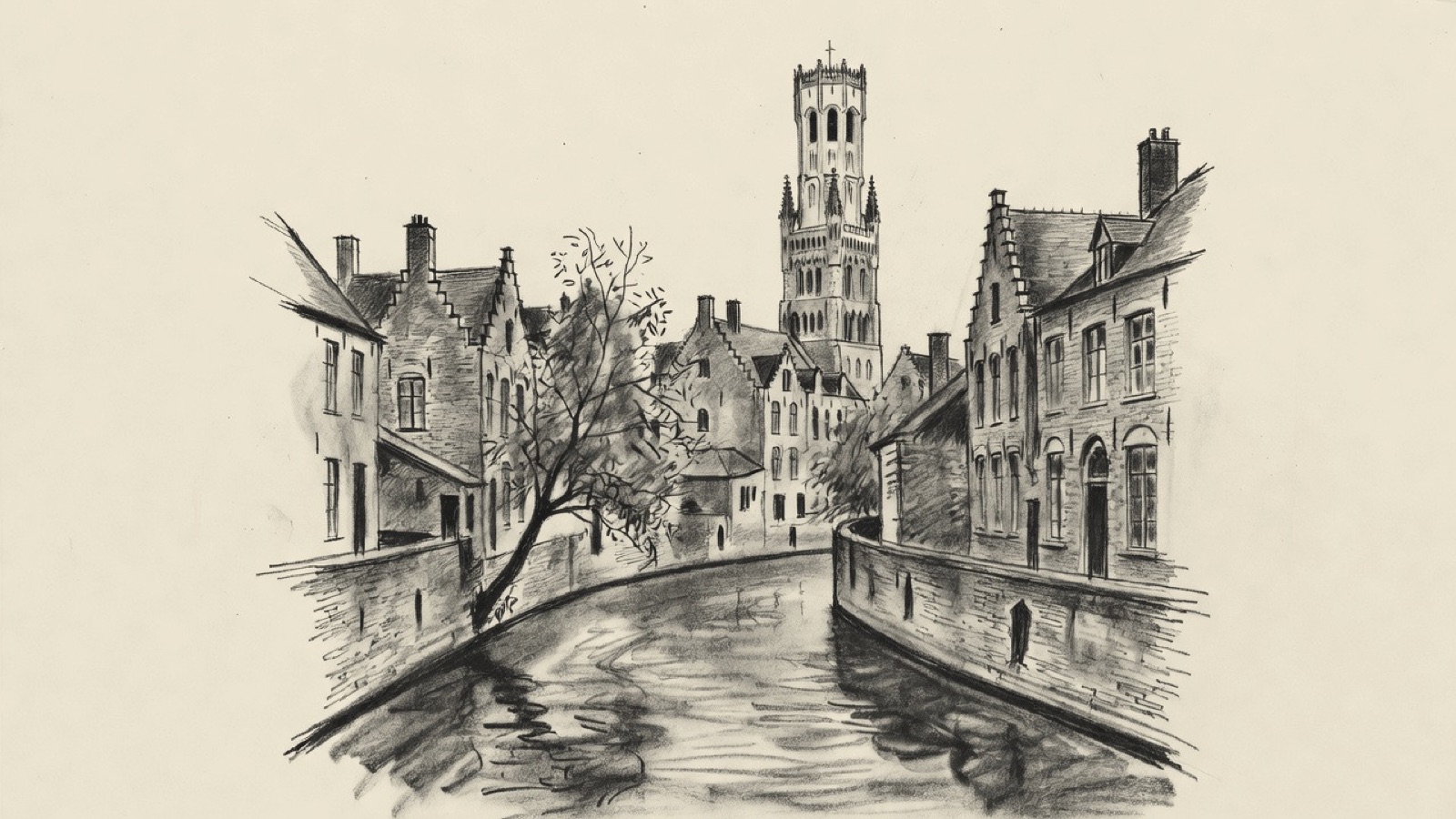
01 / Choose a walk
Five ways into Bruges
Start with the part of the city that interests you. Each route puts its stops in walking order, with the map ready to open when you need it. You decide where to pause and when to continue.
01Guilds, counts & trade
Markt and Burg: from the city gate to the trades' squares
A walk of sixteen stops from a gate on the edge of Bruges to the Markt and the Burg, then on to the trades' squares. Look for two rounded towers on the gate, a belfry leaning to the south-east and slate-spired turrets on the town hall. Further on come a double colonnade round a fish market and a saint clasping a crucifix on a bridge.
02Gates, museums, churches
Gentpoort to Simon Stevinplein: gates, art and churches
A bridge in two parts over the Ringvaart opens a route past two city gates and the Poertoren, an 18-metre tower that stored the city's gunpowder from 1477. Further on come BRUSK, the Groeningemuseum, Michelangelo's marble Madonna of Bruges and a church with flying buttresses from the 1270s. The last stop is the statue of Simon Stevin.
03Squares and trade
Around Jan van Eyckplein: squares, Jesuits and trade
Seven squares lie on this route, from Woensdagmarkt to Oude Beursplein, and Torenbrug at the start spans two named waters. Along the way are a 17th-century Baroque church built by the Jesuits, a palace of 1435 that housed a Medici bank, and a 14th-century building with its date on the façade.
04Gate & care
Smedenpoort to Sint-Janshospitaal: a city gate, a square and the houses of religious women
Two round towers painted ochre around the passage of a medieval gate. A uniform row of painted fronts on 't Zand, left over from a bigger plan. Then the béguinage of Bruges, entered by a monumental gate, and a medieval hospital that now holds museums.
05Mills, lace, convents
Sint-Anna and the Kruisvest: mills, convents and lace
Two grain mills stand on the Kruisvest, one built in 1770 and one in 1996. Further on come the house where the poet Guido Gezelle was born, the domed church of the Engels Klooster and the lace school of the sisters who began teaching lace in 1717.
Our first five routes cover the south around the Church of Our Lady, the centre with the Markt and the Burg, the merchants’ quarter, the west around ’t Zand and the east as far as the windmills. Damme, Lissewege and the port and beach at Zeebrugge lie outside the historic centre and are not yet included in the route collection.
Your pace, your stops
We don’t give walking times: everyone moves through a city at a different pace. A route is a suggestion that links places worth seeing. You decide where to stop and what you can take on today.
How these routes were made
The Bruges routes were proposed from open map data, written from published sources and illustrated in charcoal. The walking tracks were calculated on a map and have not yet been checked on foot. The drawings are interpretations, not surveys. Read how the guide is prepared.
02 / Before choosing
The places to make room for
Bruges’s landmarks sit close together, but several of them are interiors that need a visit of their own. These are the places to bear in mind as you choose what to explore.
01
The Markt and the Burg
Two squares a short way apart. The Markt has the Belfry, 83 metres high, over the old market halls. The Burg has the City Hall, built between 1376 and 1421 and still the seat of the city council, and the Basilica of the Holy Blood. Both squares are seen from outside on the route. The climb up the Belfry and the Gothic hall of the City Hall are separate visits run by Musea Brugge.
02
The Church of Our Lady and the museums beside it
The southern route ends among the city’s main collections. The Church of Our Lady, with a brick tower 115.5 metres high, holds Michelangelo’s marble Madonna and Child and the tombs of Charles the Bold and Mary of Burgundy. Next door, the Gruuthuse palace has a fifteenth-century oratory that looks into the church. The Groeningemuseum, which shows the Flemish primitives, is due to close for a refurbishment planned to last four years; Musea Brugge says the core of the collection will then be shown at BRUSK. Check Musea Brugge before you go.
03
The merchants’ quarter
Jan van Eyckplein was the medieval port, where ships were loaded and unloaded in front of the Toll House. The Poortersloge, the Burghers’ Lodge, was built between 1395 and 1417 for the city’s patricians and merchants, who received their trading partners there. Foreign trading nations kept their houses in the streets around it. The lodge now shows contemporary art; check what is on before counting on going in.
04
St John’s Hospital and ’t Zand
The hospital of Sint-Jan was founded in the twelfth century and is one of the oldest hospital buildings preserved in Europe. Its museum shows seven works by Hans Memling, four of them painted for the hospital itself, with the St Ursula Shrine in the hospital church. The same route passes ’t Zand, the city’s largest square, where the railway station stood until the early twentieth century and the Concertgebouw stands now.
05
The east: the Jerusalem Chapel, lace and the windmills
The eastern route runs through the quarter of Sint-Anna to the ramparts. The Jerusalem Chapel was rebuilt for Anselm Adornes on the model of the Church of the Holy Sepulchre and still stands on his family’s estate. The Lace Centre occupies a former lace school. Four windmills stand on the rampart; the Sint-Janshuismolen, of 1770, is the only one that still grinds grain. From December it opens on one Sunday a month, so read the Musea Brugge page first.
03 / Look closer · Markt
Read the Belfry from the bottom up.
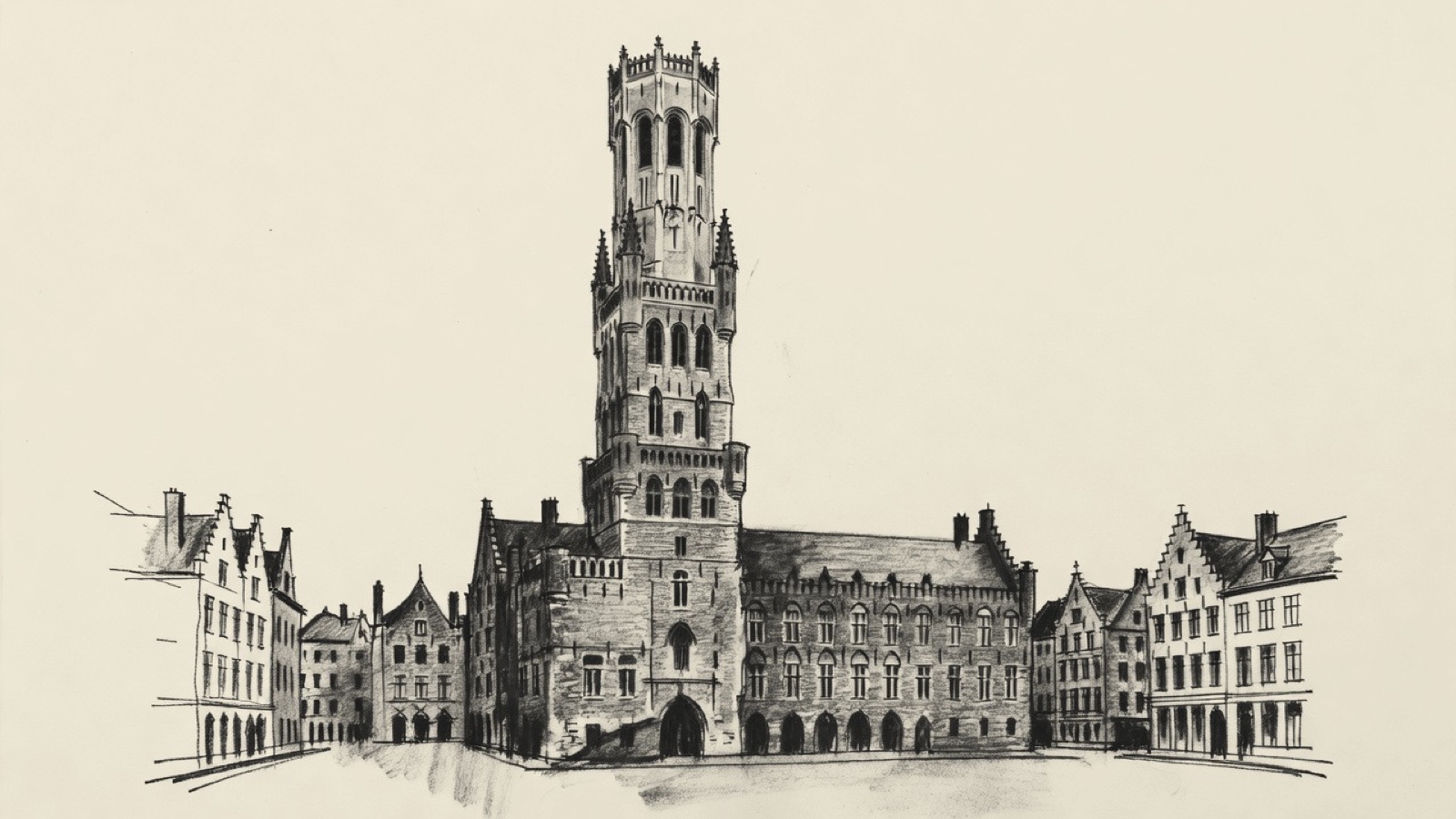
From the Markt the Belfry reads as three stages stacked above the roofs of the old market halls, each narrower than the one below. The two lower stages are square and built of brick. The third is eight-sided and built of sandstone. Halls and tower went up together in the last two decades of the thirteenth century, after a fire in 1280. The tower is 83 metres high.
Start above the main gate. Over the balcony, a round-arched Renaissance niche holds a statue of Our Lady, a copy made in 1911 of a sixteenth-century design by Lancelot Blondeel. A small bear carrying the city’s arms sits on top of the frame. The city clock was fixed to this face in 1449–1450 and moved up to the octagon in the 1560s, where its dials are today.
The octagon was added between 1482 and 1486, and its top ends in an open balustrade between pinnacles, like a crown. It was not meant to end there. It first carried a wooden spire with a figure of St Michael, which burnt in 1493. A second spire, finished in 1502, had a lion on top. Lightning set the tower on fire in 1741, and it was repaired without a spire.
The tower also leans. Reports of it alarmed the city in 1523, and in 1554 the corners were strengthened with heavy sandstone piers. A study made for the restoration of 1964–1975 measured an average lean of 87 centimetres towards the south-east and judged it harmless. The tower was already off the vertical when its first stage was built, so each later addition was set to correct the one beneath.
Where to stand. Stand back in the square, facing the gate. This is the north face, so the lean runs away from you and to your left, towards the Wollestraat. Going up is a separate visit of 366 steps; check Musea Brugge before you go.
The Flemish heritage inventory describes the halls and the Belfry stage by stage →
04 / Getting around
Walk the centre. Take the bus to its edges.
The city’s tourist office calls walking the best way to see Bruges: the historic centre is compact, and the sights lie close to one another. Each of the five routes is walked from end to end. Bruges has no tram or metro. The buses, run by De Lijn, are for the stretch between the station and the centre and for the outer ends of the routes.
Arriving by train
The station to get off at is called Brugge, on Stationsplein, on the edge of the historic centre. Brugge-Sint-Pieters is a different station, further out; the tourist office warns visitors not to confuse the two. It lists direct trains to Brugge from Brussels, Ghent, Antwerp, Leuven and Hasselt, and three trains an hour from Brussels-South, bound for Ostend, Knokke or Blankenberge. International trains arrive in Brussels-South, where you change. SNCB lists luggage lockers, a ticket office and connecting buses at the station.
From the airports
Brussels Airport has a railway station beneath the terminal, and the airport lists Bruges among the cities reached by train without a change. Journeys to and from that station usually carry a rail supplement, €6.90 when we checked, which is often already included in the ticket price. Ostend-Bruges Airport is on the coast, outside Ostend. Its website points passengers to a De Lijn bus that stops in front of the terminal and runs to Ostend; trains to Bruges leave from Ostend station. Look up the current bus in De Lijn’s route planner before you travel. From Brussels South Charleroi Airport the tourist office lists a direct coach that stops behind Bruges station.
Buses
The station and ’t Zand square are the two hubs: the tourist office says every bus calls at both, and that a bus runs between the station and the centre every five minutes. Stops in the centre carry the names of places on these routes, among them ’t Zand, Sint-Salvatorskathedraal, O.L.V. Kerk, Dijver, Stadsschouwburg and Jan Van Eyckplein. One ticket allows changes within its validity. De Lijn runs evening services on a number of lines, and later ones on Friday and Saturday nights. Timetables change for road works and events, so check the line and the stop in De Lijn’s route planner on the day.
Single ticket · 60 minutes
Valid on De Lijn buses, changes included. It can be paid contactless on board with a bank card or phone held to the white terminal, for up to five travellers. Bus drivers do not take cash.
Day ticket · 24 hours
Unlimited travel on De Lijn for 24 hours; €4.50 for children aged 6 to 11. The 3-day ticket costs €18 for 72 hours. Sold in the app, at ticket machines and in Lijnwinkel shops, not on board.
10-journey ticket
Ten journeys of 60 minutes each, which comes to €2.20 a journey. Several people can share one: scan it once for each passenger.
Count the journeys before buying. Most visitors to Bruges need the bus only to and from the station, and two single tickets cost €6. Three singles cost €9, the price of the day ticket, so the day ticket is the cheaper choice from the fourth journey in 24 hours. The 10-journey ticket costs less than singles from the eighth journey. Buy or activate a ticket before boarding unless you pay contactless on the bus. In Bruges the tourist office lists a Lijnwinkel on Stationsplein and ticket machines there and at the ’t Zand stop. Children under six travel free with a paying passenger aged 12 or over.
05 / At the table
A few words worth recognising on a menu.
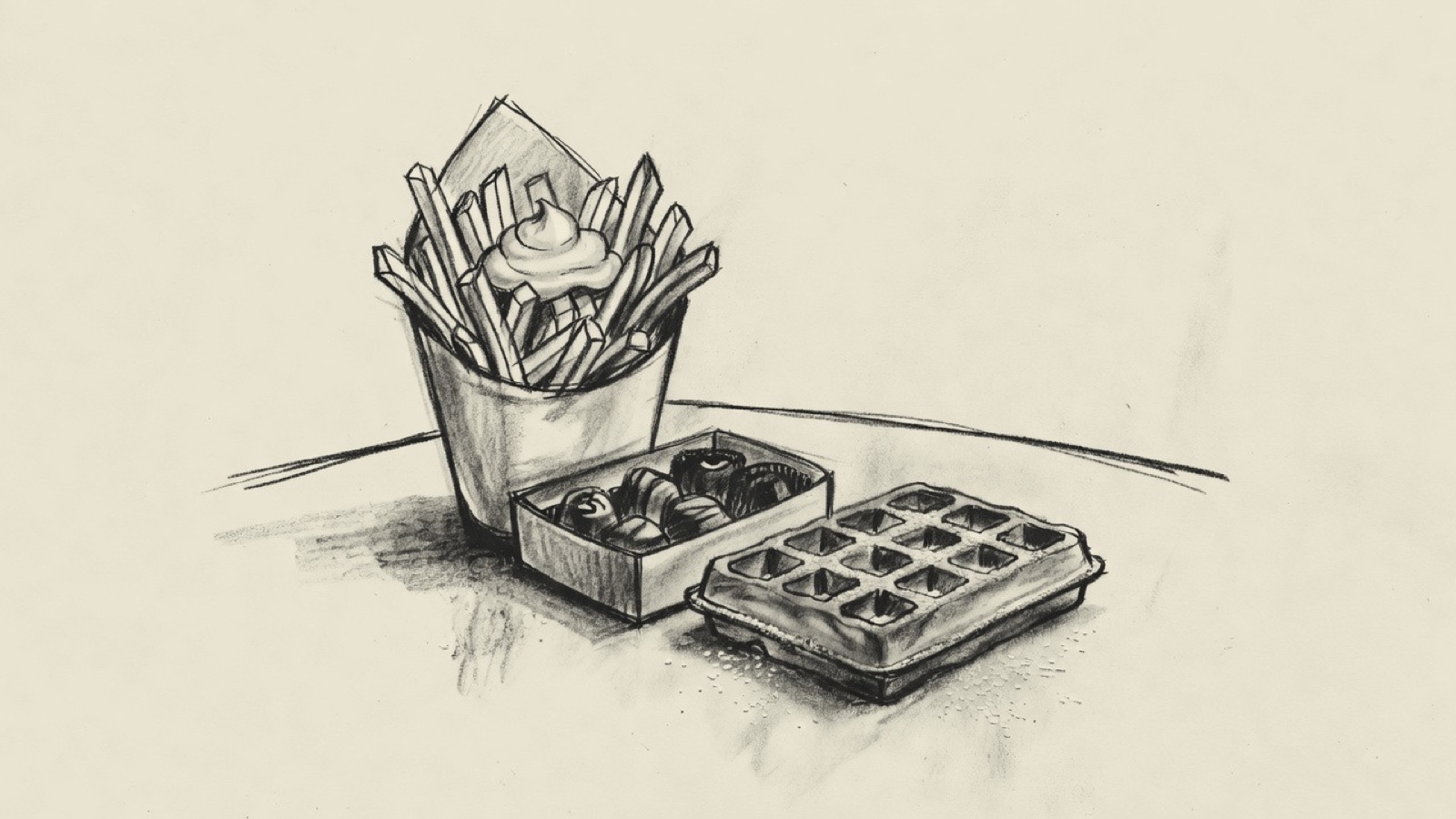
Bruges eats from the Flemish repertoire, with the North Sea close by. Recognising a few words is more useful than arriving with a list of things to tick off.
Frietjes
Fries. A frituur is a kiosk or small restaurant that sells them with other fried snacks. The usual order is a cone with mayonnaise on top. Stoofvleessaus is the alternative: the sauce of the beef stew, cooked with onions and brown beer.
Flemish beef stew
Tougher cuts of beef are simmered slowly with onion in beer until they fall apart, and the sauce is bound with bread spread with mustard. The result is sweet and sour, and it comes with fries.
Garnaalkroket
A croquette filled with North Sea shrimp. The shrimp is the small grey one, less than a centimetre long once peeled. The same shrimp fills a hollowed tomato served with mayonnaise, another standard of the menu.
Mussels and fries
A pot of mussels served with fries. The plain version is cooked with onion and celery. Flanders’ tourist board gives the season as July to February.
Brussels and Liège waffles
The two kinds of waffle you will see named. The Brussels waffle is rectangular, light and crisp, made with yeast and eaten with icing sugar or whipped cream.
Praline
In Belgium the word means a filled chocolate, not a nut sweet. The first was made in Brussels in 1912. A ballotin is the box they are sold in.
Speculaas
A thin, crunchy spiced biscuit, often served with coffee. Cinnamon, nutmeg, clove and ginger are among the spices.
Brugse Zot
On a drinks list, the beer the tourist office calls the city’s own. A brown café is a traditional pub, named for its dark wood interior.
Food background: Visit Flanders on fries and the dishes served with them
06 / A little local knowledge
The city carries on around you.
Share the street with bicycles
Nearly every street in the historic centre belongs to a bicycle zone. Motor vehicles may not go faster than 30 km/h there and may not overtake a cyclist, so bicycles set the pace of the traffic. The city asks cyclists in turn to slow down for people on foot around the Markt, the Burg and Katelijnestraat, where the crowds are thickest.
Leave the car at the edge
Steenstraat is closed to cars every afternoon from 1 pm to 6 pm, and Katelijnestraat and the streets beside it are restricted during the same hours; a wider zone is restricted on Saturday and Sunday afternoons. Cameras read number plates and fines follow. Coaches are not allowed into the centre at all. Street parking in the centre is limited to four hours. The city points drivers to the free car parks on the outskirts or to the underground car park at the station, where the parking ticket includes the bus into the centre.
Look for Brugge, not Bruges
Bruges is in the Dutch-speaking part of Belgium, and its Dutch name, Brugge, is the one on the station and in the names of the bus stops. A plein is a square, a markt a market square, a kerk a church, a molen a mill; the stadhuis is the city hall and an apotheek a pharmacy. The tourist office adds that many residents also speak French or English.
07 / Continuing your trip
Other cities by train
When you are ready to leave Bruges, compare departures from Brugge station. Brussels, Ghent, Antwerp, Ostend and Paris are onward options; check the actual journey and return times before making plans.
By train
Brussels
Find the trains that suit your trip
By train
Ghent
Find the trains that suit your trip
By train
Antwerp
Find the trains that suit your trip
By train
Ostend
Find the trains that suit your trip
By train
Paris
Find the trains that suit your trip
Train searches open on Railclick. Check prices and conditions there before booking.
Facts on this page come from the official pages below, read on the date shown. Fares and services change: confirm with the operator before travelling.
- De Lijn fare overview: single €3; return €6; 10-journey €22 (€2.20 a journey); 50-journey €95; day ticket €9 (€4.50 for ages 6–11); 3-day ticket €18 (€9 for ages 6–11); buy or activate before boarding unless paying contactless on the vehicle; children under six free with a paying passenger aged 12+. · read 2026-10-10
- Single ticket €3, 60 minutes on all De Lijn buses and trams; contactless payment on the vehicle at the white terminal, up to five travellers; same card or phone held to the terminal again at each transfer within 60 minutes; card tickets scanned on boarding and at each transfer. · read 2026-10-10
- Day ticket €9 for 24 hours (€4.50 ages 6–11); sold via app/website, SMS, ticket machine and Lijnwinkel (no on-board sale listed). · read 2026-10-10
- 3-day ticket €18 for 72 hours (€9 ages 6–11); app/website, ticket machine or Lijnwinkel. · read 2026-10-10
- 10-journey ticket €22, 60 minutes per journey; can be used by several people, scanned once per passenger. · read 2026-10-10
- De Lijn evening transport in the Bruges region: a number of lines run in the evening (until about 11 pm) and on Friday and Saturday nights (until about 2.30 am). · read 2026-10-10
- Visit Bruges, ‘Travelling to and in Bruges’: walking as the best way to explore, compact centre; take a train that stops at ‘Brugge’, not ‘Brugge Sint-Pieters’; Brussels-South as the international hub, three trains an hour to Bruges ending in Ostend, Knokke or Blankenberge; 1 to 4 direct trains an hour from Antwerp, Ghent, Hasselt, Leuven and Brussels; Brussels Airport station below the terminal with a direct service to Bruges; Charleroi airport coach stopping at the rear of Bruges station; Ostend-Bruges Airport by bus to Ostend station and train to Bruges; a bus every 5 minutes between station and centre; station and ’t Zand as hubs that all buses pass; names of the centre stops; €3 ticket bought on the bus contactless only, at the Lijnwinkel on Stationsplein or at machines at Stationsplein and ’t Zand; bicycle zone (30 km/h, no overtaking of cyclists, watch for pedestrians at Markt, Burg, Katelijnestraat); 30 km/h in the whole centre; coaches not allowed in the centre; free peripheral car parks and P+R; bus ride included in the Centrum-Station car park ticket. · read 2026-10-10
- Car-free and restricted streets: Steenstraat car-free 1 pm–6 pm daily; Katelijnestraat and adjacent streets restricted 1 pm–6 pm daily; green zone restricted 1 pm–6 pm on Saturdays and Sundays; enforcement by number-plate cameras, fines. · read 2026-10-10
- Parking: above-ground parking in the centre limited to 4 hours (9 am–8 pm); free peripheral car parks and park-and-rides; Centrum-Station parking ticket gives free bus tickets to the centre for up to 4 people per car; no coaches in the city centre. · read 2026-10-10
- Practical info: Belgium has three official languages; Bruges is in the Dutch linguistic area, many residents also speak French or English; ‘Apotheek’ = pharmacy; left-luggage lockers at Bruges station. · read 2026-10-10
- Brugge station: address Stationsplein 5; luggage lockers, ticket office, ticket machines; Blue-bikes; connecting buses. · read 2026-10-10
- Brussels Airport-Zaventem station is directly beneath the terminal; Bruges reached without transfers; rail surcharge (Brussels Airport Supplement) of €6.90 usually applies and is often included in the ticket price. · read 2026-10-10
- Ostend-Bruges Airport: a De Lijn bus linking Ostend, the airport, Nieuwpoort, Koksijde and Veurne stops right in front of the terminal; passengers told to check delijn.be and SNCB before travelling. · read 2026-10-10
- Belfry and halls (Belfort-Hal): built as one after the fire of 1280, in the last two decades of the 13th century; 83 m; square base and eight-sided upper stage of Brabant sandstone; clock on the north side 1449–1450, moved to the octagon 1562–1567; octagon added 1482–1486 with wooden spire and St Michael; spire burnt 1493; new spire 1499–1502 with lion; 1741 lightning fire, repaired without spire; lean reported 1523, corners reinforced with sandstone piers 1554; stability study during the 1964–1975 restoration: average lean of 87 cm to the south-east, not dangerous, tower already leaning when the first stage was built; balcony of the ‘Hallegeboden’; Renaissance niche with statue of Our Lady (1911 copy by M. D’hondt after L. Blondeel) crowned by a bear with the city arms; oculus with royal coat of arms on the second stage; flying buttresses from the corner turrets; top finished as a crown; Wollestraat on the east side, Markt wing on the north. · read 2026-10-10
- Poortersloge: seat from 1417 to 1715 of the Society of the White Bear, a jousting society, with the bear in the left niche of the front façade. · read 2026-10-10
- Musea Brugge, Belfort: 83 metres, 13th century, 366 steps, carillon of 47 bells; closed for maintenance 19–22 October 2026. · read 2026-10-10
- Musea Brugge, Museum of the Church of Our Lady: brick tower of 115.5 metres; Michelangelo’s Madonna and Child; mausoleums of Charles the Bold and Mary of Burgundy. · read 2026-10-10
- Musea Brugge, Groeningemuseum: Flemish primitives (Jan van Eyck, Hans Memling, Gerard David); the museum closes on 11 January for a four-year complete refurbishment, after which the heart of the collection is shown at BRUSK. · read 2026-10-10
- Musea Brugge, Gruuthusemuseum: late 15th-century oratory connecting the palace with the Church of Our Lady. · read 2026-10-10
- Musea Brugge, City Hall: built 1376–1421, one of the oldest city halls in the Low Countries; Gothic Hall; the city council still meets there. · read 2026-10-10
- Musea Brugge, Museum Sint-Janshospitaal: 12th-century hospital, one of Europe’s oldest preserved hospital buildings; seven Memling works, four made for the hospital; St Ursula Shrine in the hospital church. · read 2026-10-10
- Musea Brugge, Sint-Janshuismolen: dates from 1770, original location; the only one of the four windmills on the ramparts where grain is still ground; from December open every second Sunday of the month. · read 2026-10-10
- Markt: dominated by the Belfry, 83 metres high. · read 2026-10-10
- Burg: centre of power for centuries; the city administration in the 14th-century Gothic Town Hall; Basilica of the Holy Blood on the square; bus stop named ‘Brugge Dijver’. · read 2026-10-10
- Poortersloge (Burghers’ Lodge): built 1395–1417 for the burgesses of Bruges (patricians and merchants), who received trade partners there; ships loaded and unloaded in the area; nation houses nearby; today a location for contemporary art exhibitions. · read 2026-10-10
- Jan van Eyckplein: medieval port, Toll House, Burghers’ Lodge. · read 2026-10-10
- ’t Zand: the largest square in Bruges; site of the railway station until the early 20th century; Concertgebouw. · read 2026-10-10
- Adornes estate and Jerusalem Chapel: chapel consecrated 1429, rebuilt on the orders of Anselm Adornes, inspired by the Church of the Holy Sepulchre in Jerusalem. · read 2026-10-10
- Kantcentrum (Lace Centre): housed in the renovated old lace school of the Sisters of the Immaculate Conception. · read 2026-10-10
- Belgian beer culture in Bruges: Brugse Zot described as the city’s very own beer. · read 2026-10-10
- The brown café: a traditional pub named for its warm, dark wood interior. · read 2026-10-10
- Flemish street food: garnaalkroket (shrimp croquette); frietjes, frituur, mayonnaise or stoofvleessaus (beef cooked with onions in brown beer); Brussels waffles and Liège waffles as the two main types. · read 2026-10-10
- Fries in a cone with mayonnaise; mussels and fries (season July to February, with onion and celery); beef stew simmered with onion in beer, bound with mustard bread, sweet-and-sour; tomato stuffed with grey shrimps and mayonnaise. · read 2026-10-10
- North Sea grey shrimp: less than a centimetre long once peeled; eaten in shrimp croquettes and shrimp-filled tomatoes. · read 2026-10-10
- Belgian praline: a chocolate with a soft filling, created in Brussels in 1912; the ‘ballotin’ box dates from 1915. · read 2026-10-10
- Brussels waffle: light yeast waffle, rectangular with deep holes, eaten with icing sugar or whipped cream; speculaas: thin crunchy spiced biscuit (cinnamon, nutmeg, clove, ginger among the spices), dunked in coffee. · read 2026-10-10
- Railclick’s page for Bruges–Paris (origin key ‘bruges’), the one Bruges-origin route in Railclick’s sitemap. · read 2026-10-10
- Railclick route pages with origin ‘bruges’ and destination resolved in the page data: Brussels Midi/Zuid, Ghent-Sint-Pieters, Antwerp (antwerpen-centraal), Oostende. · read 2026-10-10