Sablon to the Royal Quarter: courts, churches, museums
A cupola rebuilt higher than the one the Second World War destroyed, a Baroque slate bell tower, a former Art Nouveau department store that houses a museum, and a paved square with a rider at its centre. The route runs from the Palace of Justice through the Sablon and the Royal Quarter to the Small Ring.
4.3 km on foot · 15 stops
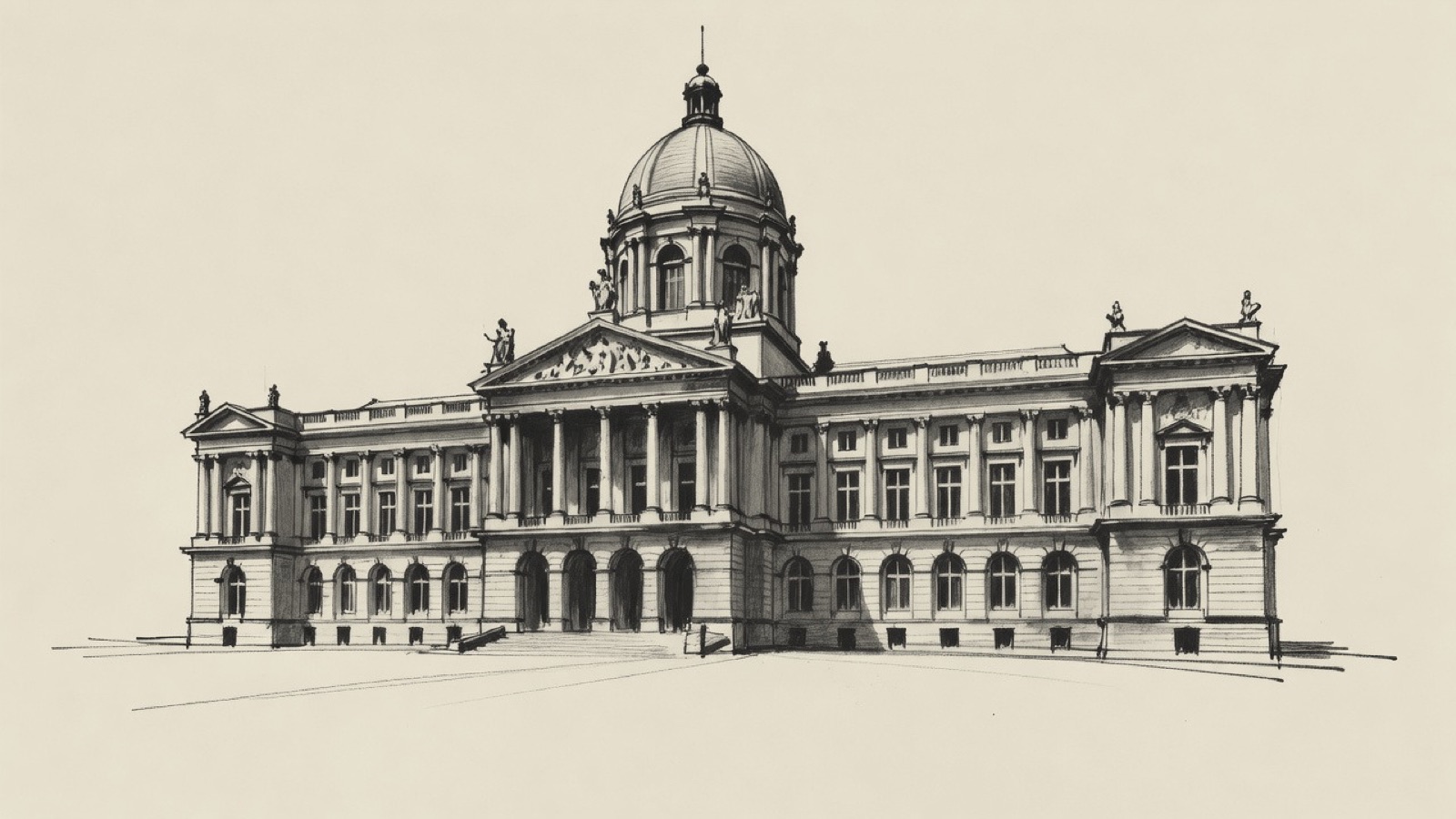
Palace of Justice · Colonnades and cupola. Charcoal illustration, not a survey drawing.
Two buildings of the 19th century open the route: the Palace of Justice, erected between 1866 and 1883, and the Great Synagogue of Europe, built in 1878. The two churches that follow are far older. The Chapel Church, raised over an earlier chapel, belongs to the 12th and 13th centuries, and the Church of Our Lady of the Sablon to the 15th, when the nobility and the wealthy citizens of Brussels were its patrons. Both were declared historic monuments in 1936.
Gilles-Barnabé Guimard had a hand in the Place Royale, the Church of St. James on Coudenberg, Brussels Park and the Palace of the Nation, all of them built between 1775 and 1787; the square and the park belonged to a single urban project. Museums are housed in neoclassical buildings of that same century, the Magritte Museum in the Hôtel du Lotto and the BELvue Museum in the Hôtel Belle-Vue. Mont des Arts comes from a later project, started under King Leopold II to house the city's cultural institutions, and the route ends on the Small Ring beside a skyscraper of 1965.
Before you set off
This route was drawn on the map and has not been walked by us yet. It has not been assessed for step-free access.
Your pace, your stops
We don’t give walking times: everyone moves through a city at a different pace. A route is a suggestion that links places worth seeing. You decide where to stop and what you can take on today.
01Belgium's chief courthouse, seat of its supreme court.50.8367° N · 4.3516° E
Palace of Justice
Joseph Poelaert designed the Palace of Justice in an eclectic style that draws on Greece and Rome, and it went up between 1866 and 1883 in place of an earlier courthouse. Its footprint covers 26,006 square metres, and it has the reputation of being the largest building put up in the 19th century. Land, construction and furnishings together came to about 50 million Belgian francs.
The Court of Cassation, which is Belgium's supreme court, sits here, along with the Court of Assizes, the Brussels Court of Appeal, the Tribunal of First Instance and the city's Bar Association. The cupola was destroyed in the Second World War and its replacement stands higher than the first one. The building is on Place Poelaert in the Marolles district, and the Poelaert Elevators link the square with the lower town.
Next on footThe Great Synagogue of Europe lies to the north-east.
02The main synagogue of Brussels, built in 1878.50.8389° N · 4.3549° E
Great Synagogue of Europe
Désiré De Keyser drew up the Great Synagogue of Europe in 1875 in a Romanesque-Byzantine style, and it was built in 1878, while the Palace of Justice was still going up. It is the main synagogue of Brussels. The Holocaust killed 25,000 Belgian Jews, and the synagogue came through it. Great Synagogue of Brussels was its earlier name, and it was dedicated in 2008 as a focal point for European Jews. Its address is 32 Rue de la Régence, in the Sablon district.
Next on footThe Jewish Museum of Belgium lies to the north-west.
03Belgium's Jewish history, in the same district as the synagogue.50.8408° N · 4.3532° E
Jewish Museum of Belgium
Belgium's Jewish history is the subject of the Jewish Museum of Belgium, which stands at 21 Rue des Minimes, in the Sablon district, like the synagogue.
Next on footThe Chapel Church lies to the north-west.
04A church begun in the 12th century, with a nave remade after a fire.50.8417° N · 4.3510° E
Chapel Church
The Chapel Church went up over an earlier chapel in the 12th and 13th centuries, in a style on the turn from Romanesque to Gothic. A fire in 1405 led to a new nave in Brabantine Gothic, widened with side chapels. The slate bell tower is Baroque and dates from the 18th century. The church has had the status of historic monument since 1936.
The church is Catholic, and its full name is the Church of Our Lady of the Chapel. It stands on Place de la Chapelle, between Rue Haute and Rue de la Chapelle, in the Marolles district, the same district as the Palace of Justice.
Next on footThe Church of Our Lady of the Sablon lies to the south-east.
05The 15th-century church of the nobility and the wealthy citizens.50.8402° N · 4.3564° E
Church of Our Lady of the Sablon
The Church of Our Lady of the Sablon dates from the 15th century and had the nobility and the wealthy citizens of Brussels as its patrons. Outside it is late Brabantine Gothic; inside, the decoration is rich, and two of its chapels are Baroque. The 19th century added neo-Gothic decorative elements. Like the Chapel Church, it became a historic monument in 1936.
Its longer name is the Church of Our Lady of Victories at the Sablon. It stands along Rue de la Régence, halfway between the Palace of Justice and the Place Royale, with the Square du Petit Sablon across the street.
Next on footThe Royal Museums of Fine Arts lie to the north-east.
06Six museums under one name, from the 15th century to the present.50.8417° N · 4.3582° E
Royal Museums of Fine Arts
Six museums make up the Royal Museums of Fine Arts. The Oldmasters Museum, the Modern Museum and the Fin-de-Siècle Museum are three of them; the others are the Magritte Museum, the Wiertz Museum and the Meunier Museum. The Belgian Federal Science Policy Office counts the group among its institutions. Between them they hold more than 20,000 paintings, sculptures and drawings, from the early 15th century up to the present.
Among the Flemish old masters in the collection are Peter Paul Rubens, Jacob Jordaens and Anthony van Dyck, as well as Robert Campin, Rogier van der Weyden and Bruegel.
Next on footThe Magritte Museum lies to the north-east.
07One of the six Royal Museums, in an 18th-century building.50.8424° N · 4.3589° E
Magritte Museum
The Magritte Museum is one of the six Royal Museums of Fine Arts and is given over to the surrealist René Magritte; no collection of his work anywhere is larger. It occupies the Hôtel du Lotto, a neoclassical building of the 18th century on the Place Royale. The Musical Instruments Museum is across the street, and the Royal Palace is not far off.
Next on footMont des Arts lies to the north-west.
08A complex for the city's cultural institutions, with a public garden.50.8442° N · 4.3576° E
Mont des Arts
Mont des Arts, Kunstberg in Dutch, means the hill of the arts. Work on it started in the late 19th century, within an urban renewal project that King Leopold II launched to give the city's cultural institutions a home. The landscape architect Pierre Vacherot designed the first version, inaugurated in 1910. The layout seen today comes from a redesign by the architects Maurice Houyoux and Jules Ghobert, carried out between 1956 and 1969.
The complex takes in the Royal Library of Belgium, the National Archives of Belgium, the Square convention centre and a public garden by the landscape architect René Pechère. Its upper part lies between Rue Montagne de la Cour and the Place Royale, and its lower part between Boulevard de l'Empereur and Place de l'Albertine.
Next on footThe Musical Instruments Museum lies to the south-east.
09A museum in the former Old England department store of 1899.50.8428° N · 4.3588° E
Musical Instruments Museum
The Musical Instruments Museum has occupied two buildings since 2000. One is the former Old England department store, which Paul Saintenoy built in 1899 in Art Nouveau style. The other, adjoining it, is a neoclassical building of the 18th century designed by Barnabé Guimard.
The collection runs to nearly 10,000 instruments and has an international reputation. The museum is part of the Royal Museums of Art and History, and its address is 2 Rue Montagne de la Cour, on Mont des Arts, beside the Place Royale and across the street from the Magritte Museum.
Next on footThe Place Royale lies to the south-east.
10A neoclassical square that replaced the Palace of Coudenberg.50.8424° N · 4.3593° E
Place Royale
The Place Royale was built between 1775 and 1782 to replace the Palace of Coudenberg, to a plan by the architects Jean-Benoît-Vincent Barré and Gilles-Barnabé Guimard. Its model was the French royal square, and it formed part of an urban project that also included Brussels Park. The square is a symmetrical rectangle of 77 by 113 metres, paved all over, with an equestrian statue of Godfrey of Bouillon at its centre. In Dutch it is the Koningsplein.
Rue de Namur comes in from the south and Rue de la Régence from the south-west, while Rue Montagne de la Cour and Mont des Arts arrive from the north-west. The Church of St. James on Coudenberg and several of the city's main museums stand around it.
Next on footThe Church of St. James on Coudenberg lies to the south-east.
11The neoclassical church on the square, by one of its architects.50.8419° N · 4.3606° E
Church of St. James on Coudenberg
Gilles-Barnabé Guimard, one of the two architects behind the plan of the Place Royale, designed the Church of St. James on Coudenberg with Louis Montoyer. It was built from 1776 to 1787 and took the place of two neighbouring places of worship. The church is neoclassical; its dome, its bell tower and a coloured fresco are additions of the 19th century.
The church is Catholic and dedicated to the apostle Saint James. Since 1986 it has been the cathedral of the Military Ordinariate of Belgium. It was listed as a historic monument in 1959.
Next on footThe BELvue Museum lies to the north.
12The history of Belgium, next to the Royal Palace.50.8426° N · 4.3607° E
BELvue Museum
The BELvue Museum covers the history of Belgium and is run by the King Baudouin Foundation. Its home is the Hôtel Belle-Vue, a neoclassical building of the 18th century like the Hôtel du Lotto. It stands between the Place Royale and Place des Palais, next to the Royal Palace.
Next on footBrussels Park lies to the north-east.
13The city's first public park, laid out with the Place Royale.50.8446° N · 4.3637° E
Brussels Park
Brussels Park was the first public park in the city and is the largest in its centre, a rectangle of 13.1 hectares. Its neoclassical layout dates from 1776 to 1783 and is the work of Gilles-Barnabé Guimard and the Austrian landscape architect Joachim Zinner, within the same urban project as the Place Royale. Some people still call it the Royal Park, its earlier name; in Dutch it is the Warandepark.
Place des Palais borders the park on the south, Rue Royale on the west, Rue de la Loi on the north and Rue Ducale on the east. The principal entrance is the northern one. An avenue runs from it to the main pond, and three more avenues leave the pond with views towards the Palace of Justice, the Royal Palace and Place du Trône.
Next on footThe Royal Park Theatre lies to the north-east.
14A theatre on the edge of the park, facing the parliament.50.8458° N · 4.3653° E
Royal Park Theatre
The Royal Park Theatre stands at 3 Rue de la Loi, on the edge of Brussels Park. It faces the Palace of the Nation, the neoclassical palace that houses the Belgian Federal Parliament, where the Chamber of Representatives and the Senate meet in two separate hemicycles.
Gilles-Barnabé Guimard designed the Palace of the Nation as well, and it was built from 1778 to 1783. After Belgian independence in 1830 the Provisional Government and the Belgian National Congress moved in.
Next on footThe Charlier Museum lies to the north-east.
15Belgian art of the late 19th century, on the inner ring road.50.8475° N · 4.3698° E
Charlier Museum
The Charlier Museum exhibits late 19th-century Belgian art, and classical music concerts are often held in it. It is at 16 Avenue des Arts in Saint-Josse-ten-Noode, one of the municipalities of Brussels, on the Small Ring, the city's inner ring road.
The Madou Plaza Tower stands next to it, at 1 Place Madou. The skyscraper was built in 1965 and renovated between 2002 and 2006, and the European Commission took it over.
Three more places can be reached by public transport. For the Horta Museum and La Cambre Abbey, board a tram at Louise - Louiza. The Horta Museum is 3 stops away, at Janson, and La Cambre Abbey is 5 stops away, at Abbaye - Abdij. For the Halle Gate Museum, take the metro at Hôtel des Monnaies - Munthof and get off 1 stop later, at Porte de Hal - Hallepoort.
Check STIB/MIVB before travelling.
Facts taken from the Wikipedia articles below (Wikipedia contributors, CC BY-SA 4.0) and rewritten for this route; this is not a copy of their text. Generated with editorial rules and checked 10 October 2026. Transport lines come from OpenStreetMap: confirm with the operator before travelling.